“It’s in the Quran” is the strongest thing you can say about a Muslim baby name, and it’s also the claim most often made without checking. Baby-name websites copy each other; a citation that was wrong in 2009 is wrong on forty sites today. Here’s how to check for yourself, and where the common mistakes hide.
Table of contents
Open Table of contents
Step 1: Find the Arabic, not the transliteration
Amira, Ameera and Emira are one name (أميرة). Maryam and Mariam are one name (مريم). Start from the Arabic script, because that’s what you’ll search for. If you only have a Latin spelling, a good Arabic dictionary or a native speaker will get you the script; guessing from the transliteration is where most errors begin.
Step 2: Search the Quranic Arabic Corpus
The Quranic Arabic Corpus is a morphologically annotated text of the Quran — every word tagged with its root, part of speech and location. Search the Arabic form and you’ll get every occurrence with chapter and verse.
If the word appears, note the root and the part of speech on the result. That’s the next step.
Step 3: Rule out a look-alike
This is the mistake that catches even careful parents. Arabic is written without short vowels, so two different words can share a spelling. A name whose letters occur in the Quran is not necessarily in the Quran as a name or as the meaning you intend.
The example I use when explaining this: مات looks like the name Matt. It does occur in the Quran — as the verb māta, “he died”. A citation-copying app would happily list it as Quranic. It isn’t a name; it’s a homograph.
So check: is the occurrence the same word (same root, plausible part of speech — a noun or adjective, usually) and does the context carry the meaning you were told? Ayah (آية) is “a sign”; Rahma (رحمة) is “mercy”; Nur (نور) is “light”. Those are real. A verb that happens to share letters with a name is not.
Step 4: Verify the meaning against a dictionary, not a listicle
Even for a name that isn’t Quranic, the meaning should trace to the Arabic root in a published dictionary — Lane’s Lexicon, Hans Wehr, or a classical Arabic dictionary — rather than to another baby-name page. If a site gives a meaning with no root and no source, treat it as folklore until proven otherwise.
Some names are Persian or Turkish in origin and perfectly good Muslim names without being Arabic at all. Knowing which is which matters for the meaning: an Arabic-looking etymology for a Persian name is usually invented.
Step 5: Note where scholars differ
A handful of names carry differing scholarly views — on whether a name is appropriate, or on its origin. A good source shows both positions with their references and doesn’t issue a verdict. Be suspicious of any list that flags names as “haram” without citing who said so.
The shortcut: an app that already did the work
I built Ismi because I went through exactly this process for my own family and didn’t want to do it 1,800 times. Every name in Ismi shows its Arabic script, a transliteration, a meaning with its source, and — for 565 names — the Quran chapter and verse, each one checked against the Quranic Arabic Corpus rather than copied from another app. Look-alike words are rejected by a review step before a name goes in. Where views differ, both are shown.
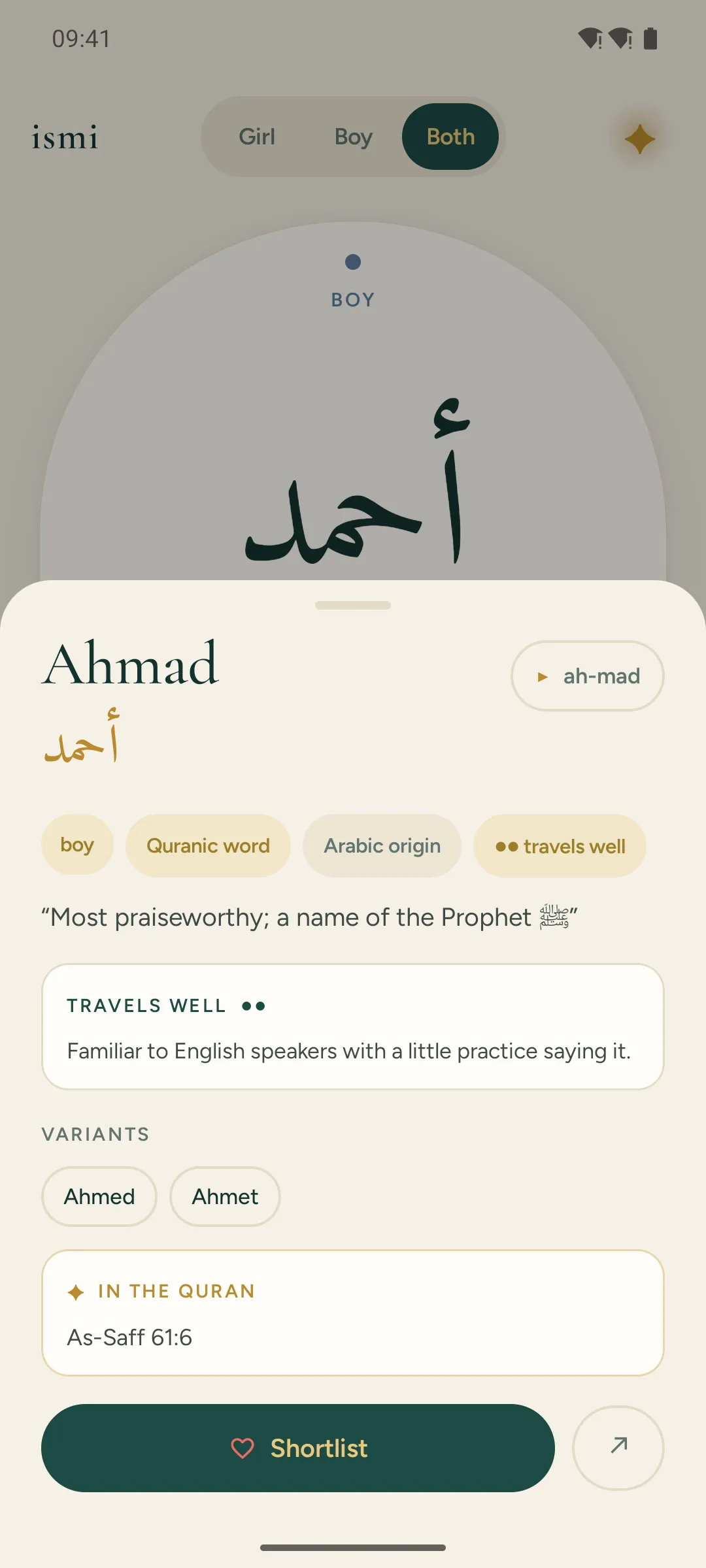
It also does the parts a dictionary can’t: swipe with your partner and match on a name you both love, filter by how easily the name travels in English, and browse by meaning theme. No ads, and it works offline. The post about how the names pipeline works has the full method if you want to audit it yourself.