You have a backlog because saving a game is free and playing one costs ten to a hundred hours. The list only grows. The real problem isn’t the size, it’s that on Friday night the one free hour goes to scrolling the list instead of playing anything from it. Here’s a system that fixes the second problem and slowly shrinks the first.
Table of contents
Open Table of contents
Rule 1: Sort by time-to-beat, not by hype
The single most useful piece of data about a game in your backlog is how long it takes to beat. A work night is a ten-hour game, not the 90-hour RPG you’re most excited about. Sort the list by length and the decision is half made before you look at titles. Community estimates from HowLongToBeat-style data are good enough; you’re not planning a speedrun.
Rule 2: Four statuses, and one of them is “Abandoned”
Wishlist, Playing, Beaten, Abandoned. The last one is the important one. A backlog that doesn’t let you quit a game without guilt becomes a museum. If you’ve bounced off something twice, mark it abandoned, move on, and let the stats be honest.
Keep “Playing” to two or three at most: one long thing, one short thing, maybe one co-op.
Rule 3: Let something random choose on a low-energy night
Decision fatigue is the enemy, and randomness beats it. Constrain the pool — under ten hours, in a mood you’re in — and then let a die, a shuffled list, or a wheel pick. You’ll play the pick, because the decision was made for you and the constraints mean it can’t be a bad one.
Rule 4: Track finishes, not just additions
A streak of finishing something every week (a short indie counts) changes the relationship with the list. You start choosing games you can complete, which is how the pile actually shrinks. Rate each one you beat and write one sentence; in a year that’s a record you’ll enjoy more than any trophy list.
Rule 5: Add fast or don’t add at all
If saving a game takes more than two taps you’ll stop doing it, and the backlog stops being the source of truth. Share-sheet import from wherever you saw the game — a video, a thread — is the bar.
The app built around this
I wrote QuestLog because I wanted the five rules above in one place instead of a spreadsheet and a die:
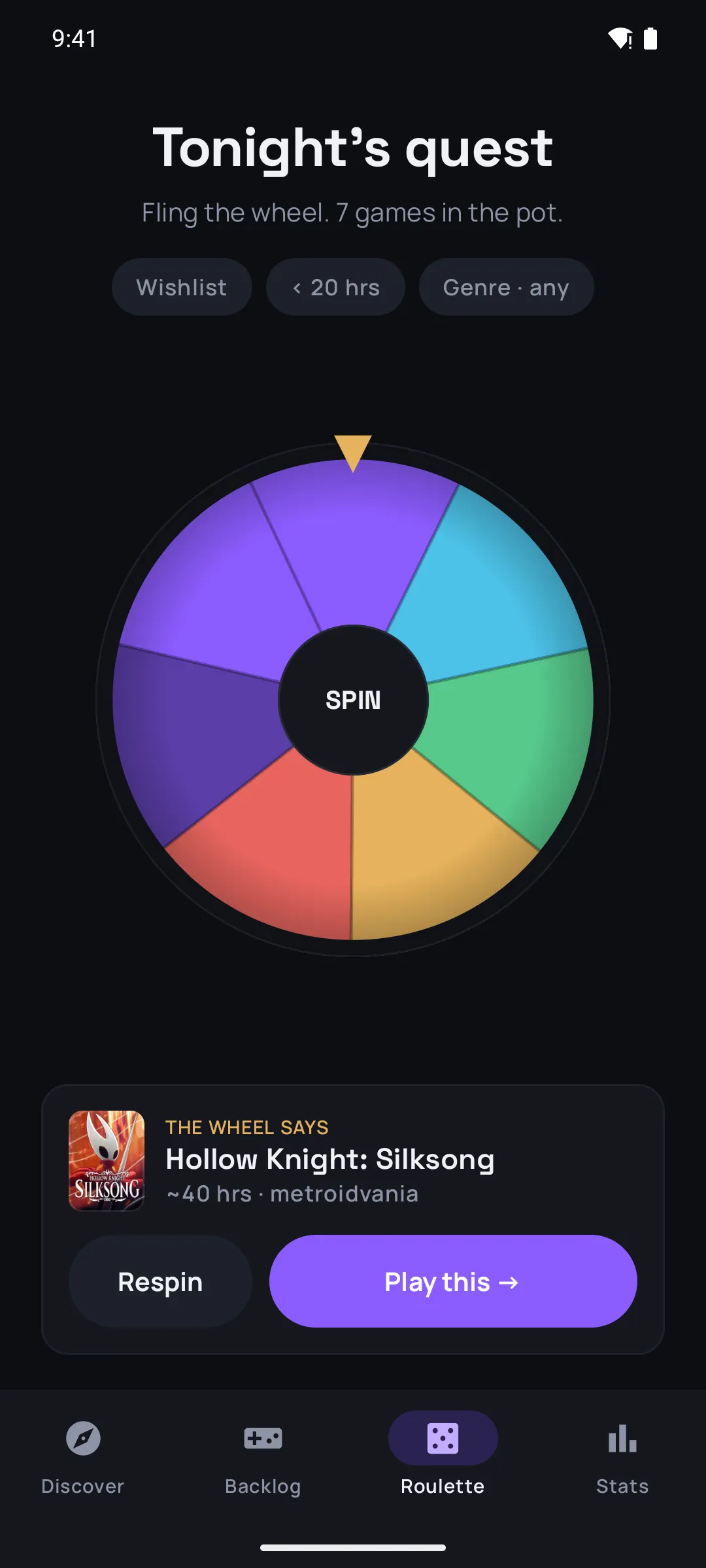
- Search 500,000+ games and add one in two taps; on Android, share a link from TikTok, YouTube or Reddit straight in.
- Time-to-beat on every game, and a roulette wheel you can filter by length and mood.
- Wishlist / Playing / Beaten / Abandoned, plus custom lists.
- Pile of shame in hours, finish streaks, year wrapped, and share cards when you beat something.
The first fifteen games are free — about one Steam sale. It’s on Google Play.
If you’d rather not use an app
A spreadsheet with four columns — title, hours, status, mood — and =INDEX(range, RANDBETWEEN(1, COUNTA(range))) in a cell is 80% of the system. The app’s job is making the other 20% (data entry, time-to-beat lookup, the wheel being fun) cheap enough that you keep doing it.